

The Question We Ask

Most approaches ask: what symptom needs reducing? We ask: what part of the self has been abandoned?

our approach banner image

The REALIGN Framework: your 7-stage pathway

Healing that lasts isn't accidental; it follows a sequence. The REALIGN Framework is the therapeutic backbone of every client journey in this practice. It was developed by Dr. Vinaya Prabha over 30+ years and has been consistently present in her practice from the beginning.
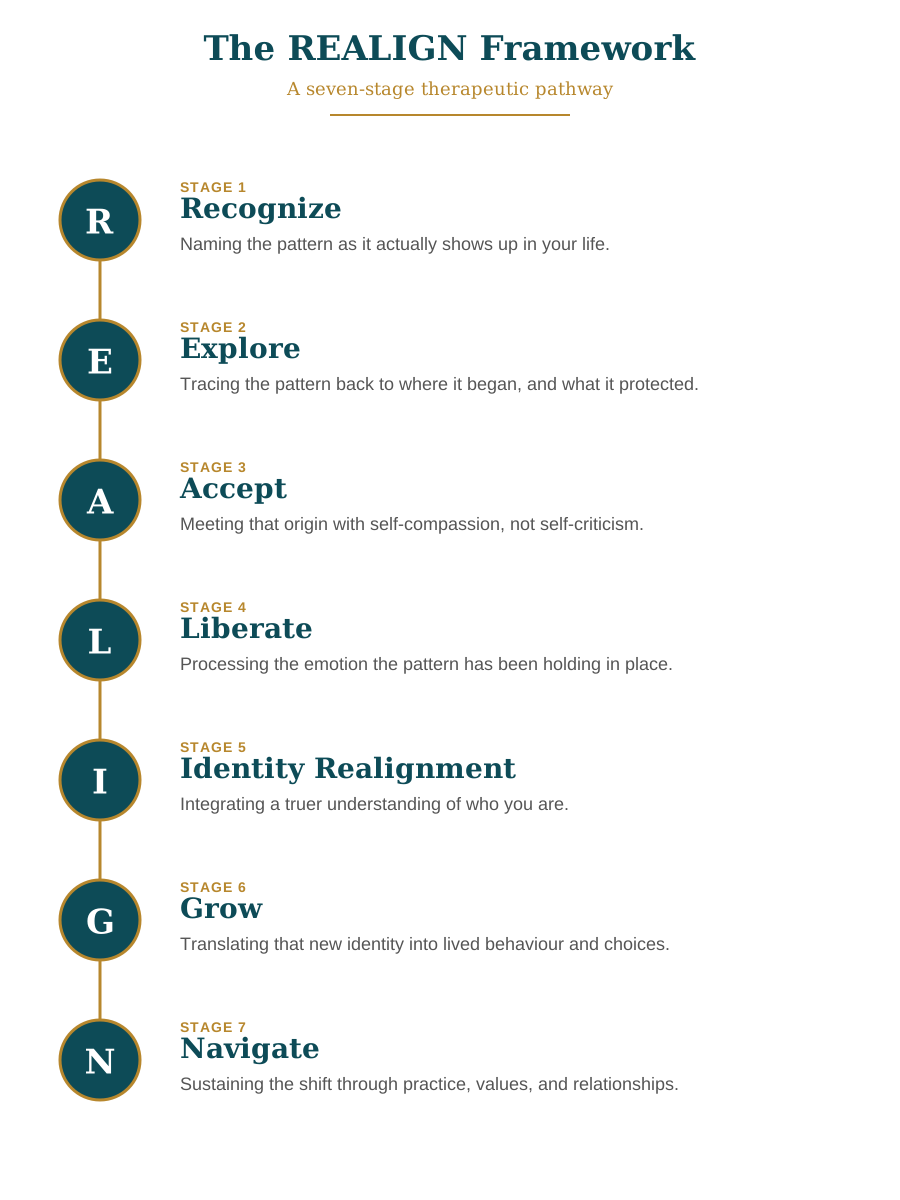
REALIGN Framework visual diagram
R

Recognize: naming the pattern as it actually shows up in your life. Seeing it clearly, perhaps for the first time.

E

Explore: tracing the pattern back to where it began, and what it was protecting you from.

A

Accept: meeting that origin with self-compassion rather than self-criticism. The ground from which real change becomes possible.

L

Liberate: processing the emotion the pattern has been holding in place. Grief, anger, longing, moved through rather than managed away.

I

Identity Realignment: integrating a new, more accurate understanding of who you are beneath the adaptation.

G

Grow: translating that new identity into lived behavior. New boundaries, new communication, new choices.

N

Navigate: sustaining the shift through the practices, relationships, and values that keep the realignment alive.

Modalities: the integrated stack

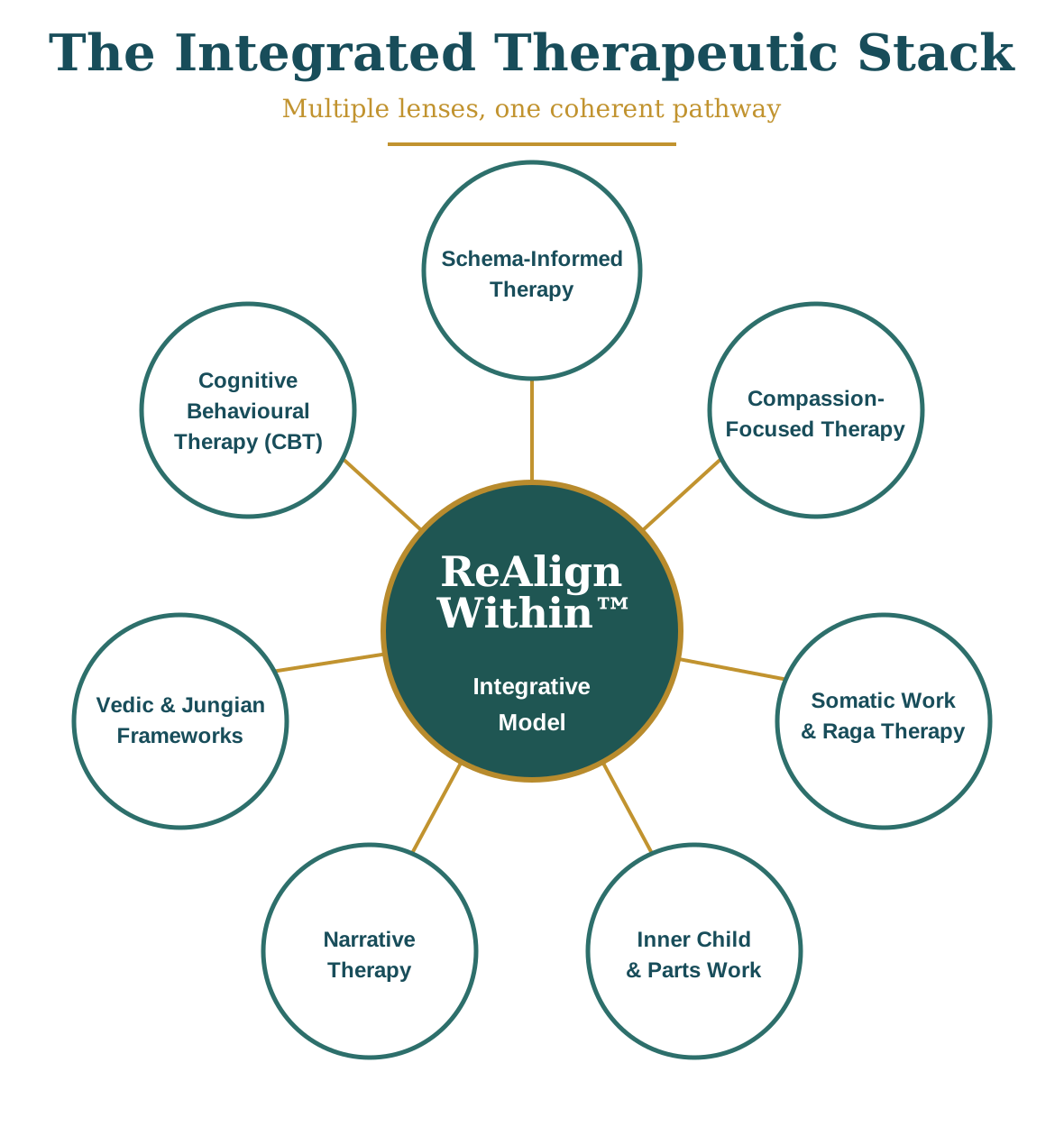
Multiple lenses, one coherent pathway.

No single therapeutic approach can hold the full complexity of identity-level work. This practice integrates several evidence-informed traditions into one coherent model, selecting the right approach for each client and each stage:

  • CBT: A structural, evidence-based therapeutic approach which provides the foundation for practical and skills-based support beneath the deeper identity work.
  • Schema-informed therapy: working with the deep, early-formed beliefs that govern how you see yourself.
  • Compassion-focused therapy: meeting your own pain and vulnerability without shame.
  • Somatic work and Raga Therapy: working with the body and nervous system. Raga Therapy is unique to this practice.
  • Inner child and parts work: working with the different selves formed at different life stages.
  • Narrative therapy: re-authoring the stories you've inherited about who you are.
  • Vedic and Jungian frameworks: archetypal and dharmic structures of meaning that resonate culturally and psychologically.
The assessment: your ReAlign Profile

A complete therapeutic blueprint, built with you.

Before depth work begins, every client receives a personalized ReAlign Profile: a comprehensive therapeutic assessment developed within this practice. It combines standard psychometric measures with a bespoke process tailored to your circumstances, goals, and the specific patterns you carry. The ReAlign Profile is not a symptom checklist. It is a portrait of you as a whole person: your history, your adaptations, your strengths, your values, and what is trying to emerge. It becomes the shared compass for your therapeutic journey.

Note: The Realign Within Profile is not a diagnostic or psychometric assessment on its own, it is a comprehensive profile of you as a person based on the Realign Within Framework. It does however include some standardised psychometric assessments given as a part of the profile customized to the client's needs.
The method in practice

Two journeys through the ReAlign Within™ framework

The following accounts are drawn from real client experiences in this practice, shared with permission and rendered with identifying details changed to protect privacy. Where a single testimonial did not contain sufficient detail for a full narrative, composite elements — clearly illustrative — have been used to honour the arc of the work without misrepresenting any individual’s story.

01

Story One: The self beneath the achievement

A senior professional | Burnout, self-doubt, and the identity beneath the performance

She arrived at the practice carrying what looked, from the outside, like a career success story. A leadership role. Recognised competence. A track record others admired. What she carried on the inside was something different: a persistent, exhausting inner voice that second-guessed every decision she made, that held her back in rooms where she knew she belonged, that made every achievement feel provisional and every mistake feel confirming.

The Recognize stage made something visible that she had not previously named: this was not imposter syndrome as a personality quirk. It was a pattern — deep, consistent, and rooted in something much older than her current role. The ReAlign Profile mapped its shape with precision: perfectionism as the primary driver, worth conditional on performance, and a self-concept built almost entirely on external validation.

The Explore stage traced the pattern to its origins. The Accept stage was, for her, the most difficult: a high-achiever’s relationship with self-compassion is rarely straightforward. The inner critic that had driven her success did not stand down easily. But it was in this stage that the most important shift began — not a silencing of the critical voice, but a gradual differentiation from it. It was something she had inherited. It was not who she was.

By the Identity Realignment stage, something had fundamentally reorganised. She began to speak in meetings not from the defended place of needing to prove herself, but from a quieter, more grounded authority. The Grow stage translated this into concrete change: new professional boundaries, a different quality of presence in leadership, and a relationship with her own judgment that no longer required constant external confirmation.

“Working with Dr. Vinaya has truly been transformative — not just for my career, but for how I see myself.” — A senior leader in Bangalore

She did not leave therapy a different person. She left it as herself — more fully, more consciously, more sustainably than she had ever been before.

02

Story Two: When the body carried what the mind would not

A professional in her forties | Emotional burnout, disconnection, and the weight beneath the weight

She came to the practice asking for help with weight loss. What the ReAlign Profile revealed, and what the therapeutic work confirmed, was that the weight was a secondary concern — a physical expression of something much larger that had been accumulating for years: emotional burnout, a pattern of chronic self-sacrifice, and a profound disconnection from her own needs and desires.

She was functioning on autopilot: showing up for everyone, carrying the emotional weight of her family and professional life, and running almost entirely on reserve. The presenting complaint — physical health — was the body’s most legible attempt to communicate what the mind had long since learned to suppress.

The Recognize stage named what was actually happening. The Explore stage traced the pattern of self-sacrifice to its roots: the beliefs about what she was for, what she was entitled to, what it meant to need something for herself. The Accept stage was slow and careful — a woman who had spent decades giving to others required a great deal of therapeutic patience to begin receiving.

The Liberate stage was where the somatic work became most important. Much of what she was carrying was not accessible through language alone: it was held in the body, in a chronic state of low-grade tension and depletion that talk therapy alone could not reach. The integrated approach — including work with the nervous system and, where appropriate, the practice’s somatic techniques — created pathways for release that began to restore a basic felt sense of safety and aliveness.

Within six months, the physical transformation had begun — not as the primary goal of the work, but as its natural expression. By the end of the year, the physical change was significant. More important, by any measure, was the internal one.

“The physical transformation was just the beginning. The real gift was the mental and emotional freedom I found. I now manage my time and energy with greater awareness, set boundaries without guilt, and handle challenges with far more resilience.” — A professional in her forties, Bangalore

The Navigate stage equipped her with a very different relationship to her own body, her own needs, and her own authority over both. She left not simply lighter in the physical sense — but with the internal architecture to remain that way.

Begin your journey

The REALIGN framework is not a programme you sign up for.

It is a pathway you begin — one conversation at a time, at a pace that is always yours to set. Your first step is a complimentary Discovery Call: a 20 to 30-minute conversation with no commitment and no clinical agenda. Simply a chance to be heard, and to find out whether this is the right space for the work you are ready to do.

Book a Complimentary Discovery Call →